
TEAM dynamics Services
Strengthening trust and collaboration so leadership teams can perform under business pressure.
Strong performance starts with how teams work together.
Ineffective team dynamics rarely appear as one obvious issue:
Meetings feel busy but inconclusive.
Decisions are reopened not because of new data but because alignment and commitment never truly formed.
Conflict gets avoided or becomes personal.
Collaboration is weak across functions and people grow more guarded.
When these patterns persist, they are signals the team dynamics need attention.
LeedHR helps leadership and management teams strengthen team efficiency by integrating individual and team emotional intelligence with a proven model of team effectiveness.
Using validated psychometric tools (EQ i 2.0, EQ 360, EQ Group Report) and team diagnostic tools, we create a clear, objective picture of how people and teams are showing up, so development targets the specific areas that matter most.

Our FrameworkS: The Guiding Star MODEL & THE EQ-i 2.0® Model
Regardless of the current state of the management team, development is always possible.
Influenced by real-world experiences as management team executive coaches working with teams, combined with a variety of researchers knowledge (Katzenbach & Smith 1993, Hackman 2002, Lencioni 2002, Wageman 2008, Hawkins 2017, Clutterbuck 2019), The Guiding Star Model describes the goals to which each management team should focus their development efforts.
What are the characteristics that a team should possess to be described as a true stellar team?
-
The core of the Guiding Star Model has two important goals:
1) individual commitment to the joint goal
2) trust and psychological safety inside the team
The ultimate prerequisite is that joint goals are its priority. These goals steer the behaviours and the choices made by each team member.
Finally, the performance of a stellar team culminates in the level of trust within the team. Further, trust shouldn’t be discussed merely as a generalized concept, but it should be decoded into parts and become concrete day-to-day actions:
• What forms trust?
• What challenges our mutual trust?
• How can we develop trust in our daily cooperation?
-
The cortex of the Guiding Star Model is formed by the primary goals. The primary goals direct the team’s attention to HOW it is working as a team together.
The way to explore and develop the management teams’ primary goals can be initiated through, e.g., reflecting the following questions:
• How is diversity within the team taken advantage of? How are differences between management team members considered - concerning both knowledge and in particular behavioural styles?
• What is the level of conflict competence within the team? Is the management team able to argue constructively?
• How do the members of the management team cooperate with each other – at meetings and especially in between the meetings?
• How do the members of the leadership team give and receive feedback? What is the feedback culture like?
• How can the team adapt resiliently to change?
-
The secondary goals include topics related to the operational management of the company, i.e., how to take into consideration both the clients (external stakeholders) and personnel (internal stakeholders) in decision-making.
In addition, there is a need for aligning direction, goals (course), and regular evaluation of success (success metrics). The building blocks of team performance are set when the final secondary goal – meeting practices – are in place.
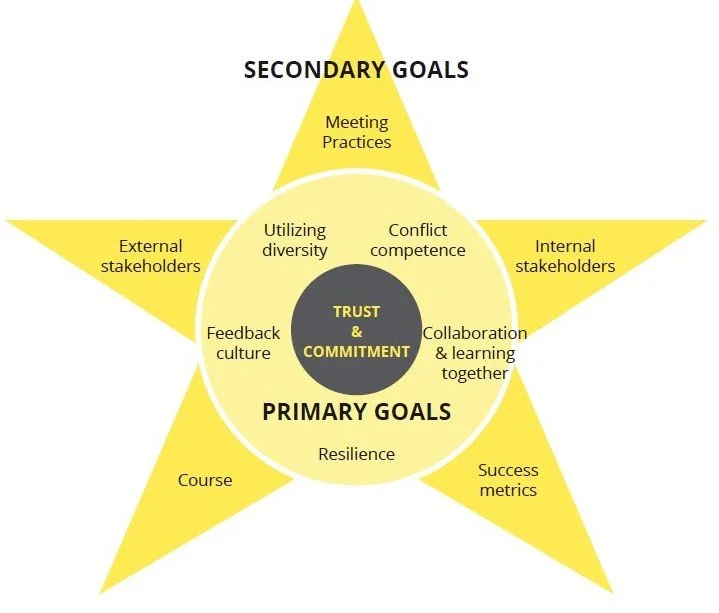
The Guiding Star Model
(Ristikangas & Rinne, 2018)
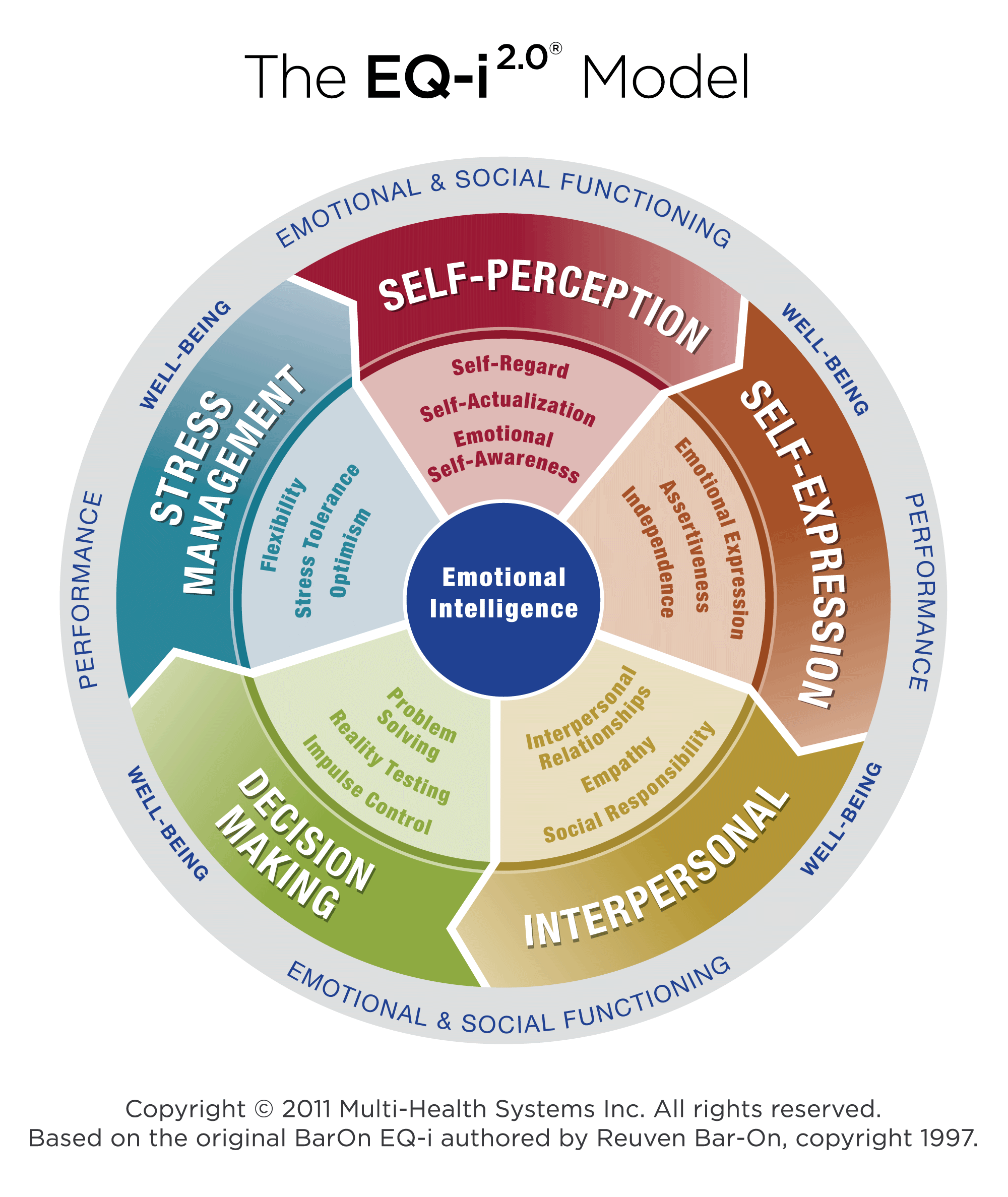
Multi-Health Systems’ (MHS) Emotional Quotient Inventory® (EQ-i 2.0®) is one of the world’s most widely used emotional intelligence tests.
Emotional intelligence skills are critical for building relationships and teams, resolving conflict, solving problems, leading effectively, and building resilience. All essential skills for stellar teams.
The EQ-i 2.0 provides participants a detailed assessment of areas of strength and potential areas for development. All in all, this comprehensive assessment is widely regarded as the gold standard of emotional assessment testing.
HOW WE WORK
Preparation and Readiness
Creating conditions for honest dialogue. Leader modeling and accountability.
Performance and Impact
Stakeholders, needs, limiting dynamics and success measures.
Scope and Contracting
Behavioural agreements, roles, expectations, feedback norms.
Individual and Team EQ
Pressure tested behaviours: listening, challenge, feedback and regulation.
Coach and Transfer
Embed practices; the team owns the rhythm and results.
Let’s work together

When team dynamics start to shift, leaders often notice meaningful changes:
Meetings move with more clarity.
Decisions stick more often.
Conversations become more direct, even when topics are uncomfortable.
People show up with greater ownership, and the team is better able to stay steady when pressure increases.
The focus is not on perfection, but on a team’s ability to navigate complexity with less friction.